
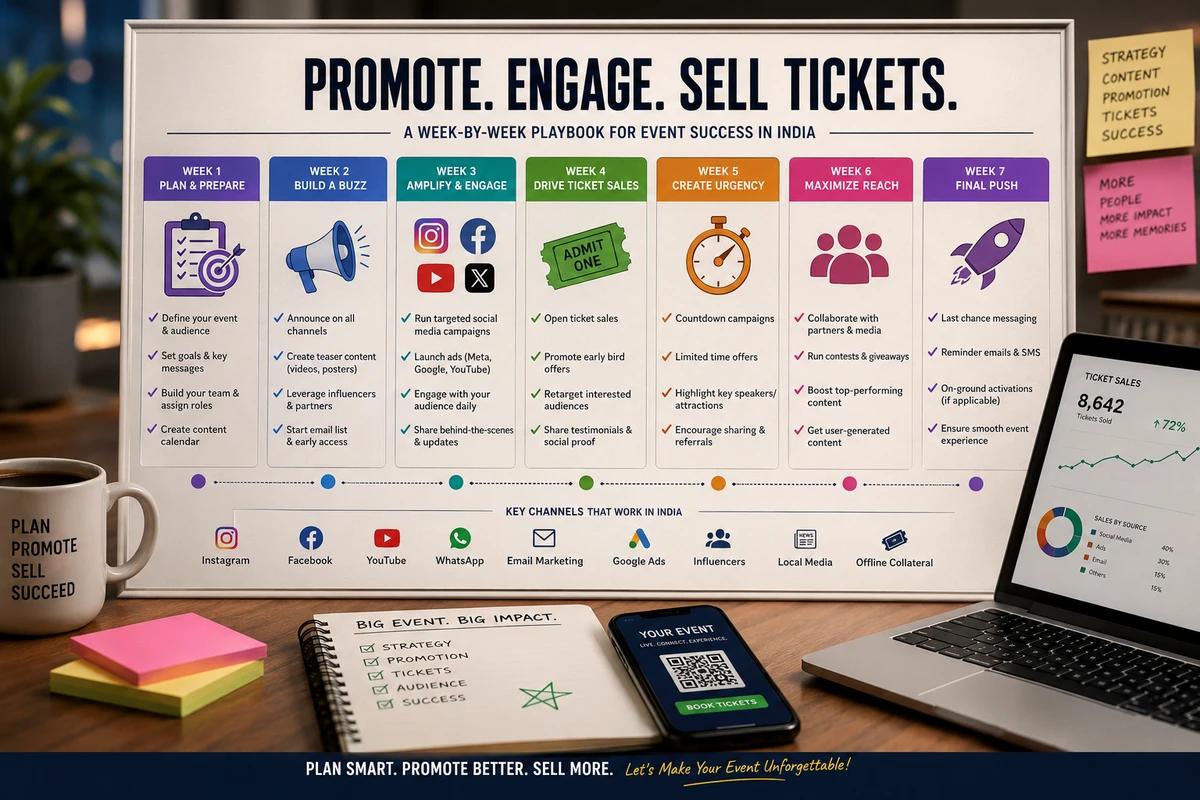
A six-week countdown built for how tickets actually sell in India — Instagram discovery, WhatsApp decisions, and momentum-first pricing.
Most event promotion advice is written for the American market and quietly assumes your audience lives on email. In India, that advice will sink you. Nobody here opens event emails. Your audience discovers events on Instagram, decides in WhatsApp groups, and books on their phone at 11 PM three days before the show.
This playbook is built for how ticket sales actually happen in India in 2026. I've structured it as a six-week countdown because timing — not budget — is what separates sold-out shows from half-empty rooms.
One market note before we start, because it should change how ambitious you are: the FICCI-EY 2026 report found live events grew 44% in 2025 — and notably, growth is now shifting beyond metros into the "next 10" cities. If you're organising in Indore, Surat, Kochi, or Lucknow, you're not fighting for scraps. You're early.
The One Principle Behind Everything: Momentum Sells Tickets
People don't buy tickets because your poster is pretty. They buy because other people are buying. An event that's "40% sold in the first week" creates urgency; an event with no visible traction creates hesitation — even if it's the same event.
Every tactic below exists to manufacture, display, or amplify momentum. Keep that lens and half of event marketing becomes obvious.
Week 6–5: Build the Asset Before the Announcement
Don't announce with a "coming soon" post into the void. Prepare the machine first:
- Event page ready before the announcement. The worst launch mistake in India: teasing an event on Instagram with "link in bio soon." You had their attention for four seconds and sent them nowhere. Your listing — with tiers, pricing, and venue — should be live before the first post. (If you haven't set that up yet, start with List Your Show; the full organiser guide covers ticketing setup in detail.)
- Price the early bird deliberately. Your first batch should be genuinely cheap — 25–35% below final price, limited quantity, visibly limited. Early bird isn't a discount; it's paid marketing. Those first 50 buyers are the social proof that sells the next 200.
- Line up 3–5 micro-collaborators. Local pages, college societies, community WhatsApp admins, niche influencers with 5k–30k followers in your city. In Indian tier-1 and tier-2 markets, five micro-pages reliably outperform one big influencer — their audiences are local and they actually show up.
Week 4–3: The Announcement and the WhatsApp Layer
Announce with the artist/act, not the logistics. Your announcement creative should answer "why should I care" in one glance. Date, venue, and price go in the caption and on the event page.
Then work the layer most organisers ignore: WhatsApp. Instagram creates awareness; WhatsApp creates decisions. Group plans are where "should we go?" becomes "book it." Practical moves:
- Create a shareable ticket link and a clean 1080×1920 story-size creative — the formats people actually forward
- Ask your first buyers (personally, via DM) to share in their groups; early attendees are flattered to be asked
- If your event suits it, run a group offer — "4 tickets, price of 3.5" — because group discounts convert entire friend circles at once, and in India, event attendance is a group decision
Use promo codes as tracking devices, not just discounts. Give each collaborator a unique code. In two weeks you'll know exactly which channels sell and which just generate likes. That data is worth more than the discount costs.
Week 2: The Mid-Campaign Slump (and How to Break It)
Every campaign has a dead zone after the announcement buzz fades and before last-minute urgency kicks in. Plan content for it in advance:
- Behind-the-scenes beats promo. Venue setup, artist rehearsal clips, soundcheck snippets. This content says "this is really happening" — which, for newer organisers, is a genuine buyer concern.
- Tier-sellout announcements. "Early bird sold out" is the single highest-converting post in event marketing. Never let a tier quietly sell out; announce it loudly and open the next tier.
- Reels over static posts. This isn't a trend take — event discovery on Instagram is overwhelmingly Reels-driven now. A 15-second clip of your last event's crowd outperforms a designed poster nearly every time. No previous event? Film the venue, the artist, the prep.
There's hard evidence for why in-person experience content works on Indian audiences: the EY-Parthenon and BookMyShow report found 78% of Indian consumers now prefer experiences over products, and 59% of live event attendees recall brands they engaged with on-ground. People aren't just attending events — they're actively looking for them. Your job is to be findable.
Week 1: Urgency, Honestly
Final-week promotion is about deadlines, and it only works if your deadlines are real. If "prices increase Friday" and prices don't increase Friday, you've taught your entire audience to ignore you — permanently, across every future event.
The final-week sequence that works:
- T-minus 7 days: "One week to go" + remaining tier availability
- T-minus 4 days: last price-increase warning (then actually increase)
- T-minus 2 days: logistics content — parking, entry time, what to bring; this converts fence-sitters because it makes attending feel easy
- Day before: final availability post + stories every few hours
- Day of: "limited door availability" only if true; many Indian audiences genuinely do book day-of, so keep selling online until doors open
The Offline Tactics Nobody Writes About
Digital gets the attention, but some of the highest-ROI promotion in India is still physical:
- Venue cross-promotion. Ask the venue to promote to their walk-in crowd and past-event lists. Venues want your event to succeed; most organisers simply never ask.
- College ambassadors. For youth-oriented events, 2–3 students with a commission code per campus beat any ad campaign on cost. They're motivated, they're trusted, and they're inside the WhatsApp groups you can't reach.
- Adjacent events. Comedy show coming up? Be present (with permission) at open mics that week. Your exact audience is standing in one room — no targeting algorithm required.
- Local press for free. City newspapers and "things to do in [city]" pages are content-starved. A short, well-written press note with a good photo often gets picked up as-is — free reach with built-in credibility.
After the Event: The Part That Compounds
The 48 hours after your event are the cheapest marketing you'll ever run for the next one:
- Post crowd photos and video while attendee excitement is peaking — they'll reshare, tagging you to their entire network
- Collect reviews and screenshots of positive messages (ask permission to post)
- Export your sales data: which code sold, which tier moved first, what day spiked. This is next event's strategy, pre-written.
- Announce your next event within a week if you can. Attendees are at maximum warmth right now; "same crew, next show" converts absurdly well.
This loop — event, content, data, next event — is how unknown organisers become names people trust. Trust is the real product; attendees book organisers, not just events. (It's also why buyers are getting careful about who they book with — see our guide on how people book tickets online for what they check before paying.)
Listing an event? Set up tiers, promo codes, and affiliate tracking on Showmates, and follow @showmates.in for promotional collaborations.
Frequently Asked Questions
Related Articles
Top New Year Events We Organise on Showmates Every Year
Every December, as people begin planning how to welcome the New Year, one question comes up again and again — where should we celebrate this time?
Read More about Top New Year Events We Organise on Showmates Every Year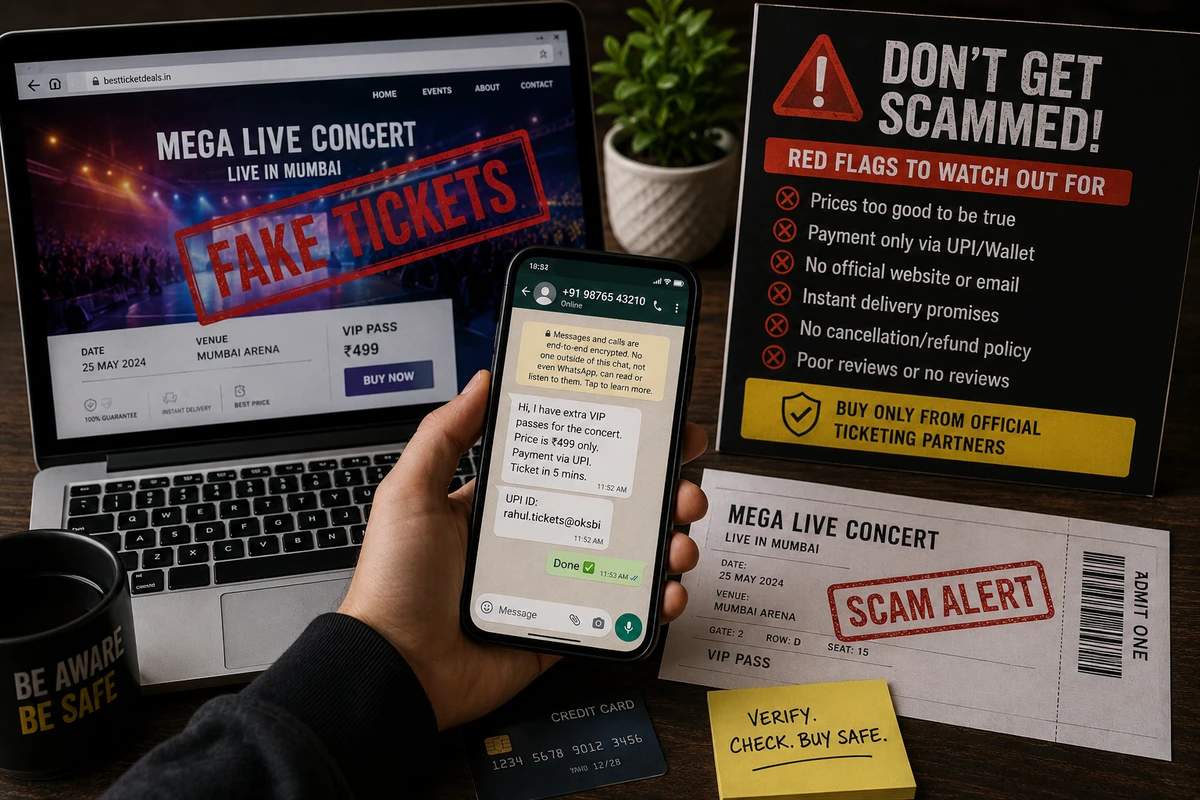
Fake Event Ticket Scams in India: How They Work and How to Not Get Burned
The four scams behind most fake ticket cases in India, the red flags that expose them, and the one buying rule that beats them all.
Read More about Fake Event Ticket Scams in India: How They Work and How to Not Get Burned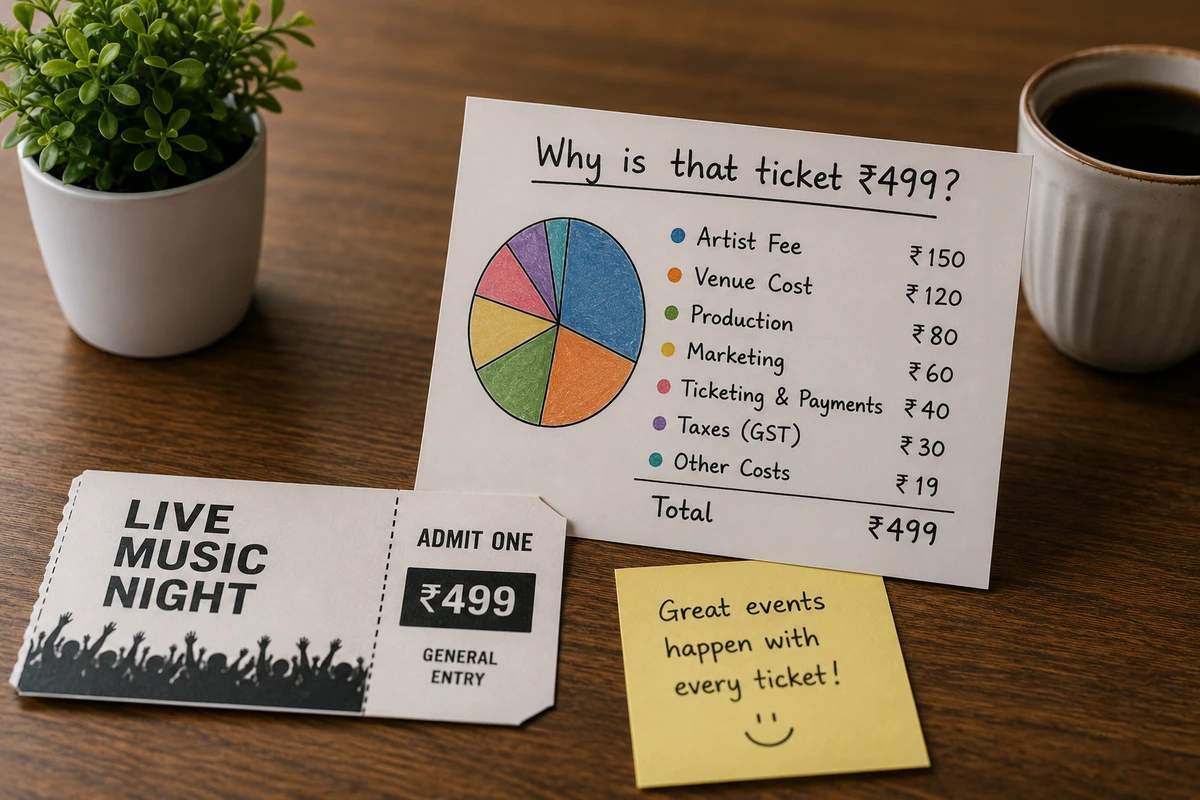
Why Is That Ticket ₹499? How Event Ticket Pricing in India Actually Works
The ₹500 GST line, early-bird economics, and unstandardised tier names — how ticket prices in India are really set, for buyers and organisers.
Read More about Why Is That Ticket ₹499? How Event Ticket Pricing in India Actually Works
India's Concert Boom Is Real: Inside the ₹13,000 Crore Live Events Economy
From 130+ arena-scale concert days to tier-2 sellouts — the numbers behind India's live entertainment surge, and where it goes next.
Read More about India's Concert Boom Is Real: Inside the ₹13,000 Crore Live Events Economy