
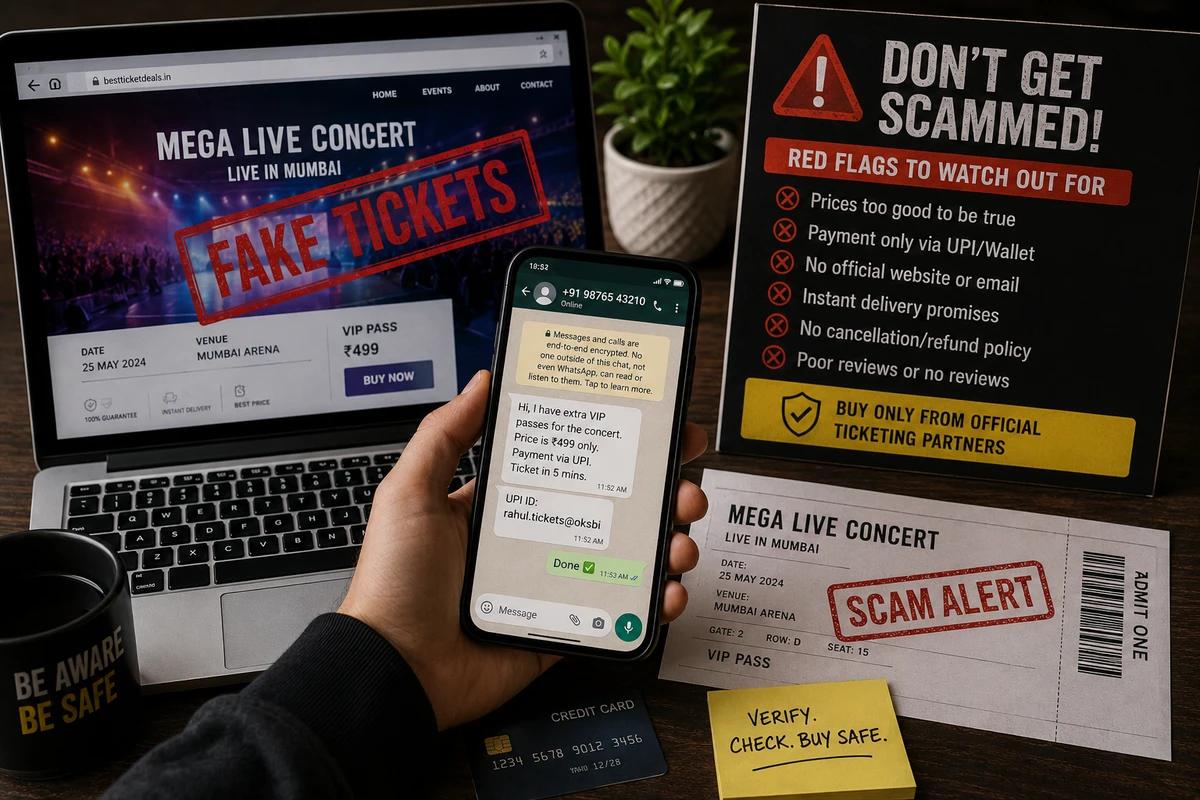
The four scams behind most fake ticket cases in India, the red flags that expose them, and the one buying rule that beats them all.
A fan in Chandigarh paid ₹8.22 lakh for 98 Diljit Dosanjh concert tickets. On show day, bouncers tore up the tickets at the gate — they were fake. In Delhi, a single seller offloaded 69 counterfeit Dil-Luminati tickets worth ₹4.76 lakh to one buyer before getting arrested. And after the Coldplay India sellout, the Enforcement Directorate raided 13 locations across five states, uncovering networks selling fake and black-market tickets through Instagram, WhatsApp, and Telegram — with resale prices reportedly touching ₹12 lakh for a single ticket.
That's the scale of India's ticket scam problem. It exploded alongside the concert boom, and it follows demand: the bigger the event, the thicker the scammers. Having watched this pattern across dozens of major shows, here's exactly how these scams work — and the checks that make you nearly impossible to fool.
The Four Scams That Cover 90% of Cases
1. The Instagram "extra tickets" seller. The most common one by far. An account DMs you (or posts in comments under the event announcement) claiming to have extra tickets for a sold-out show. Profile looks plausible — event photos, some followers, maybe screenshots of "happy buyers." You pay via UPI. You're blocked within a minute. This is the pattern the ED specifically flagged: fraudsters operating through Instagram, WhatsApp and Telegram, riding demand for sold-out events.
2. The forwarded QR code. Someone sells you a "genuine" ticket by forwarding a QR screenshot. Sometimes it's entirely fabricated. Sometimes it's a real ticket — sold simultaneously to five different buyers. QR codes scan once. First person at the gate gets in; everyone else holds a worthless image. This scam works precisely because the ticket looks authentic — it may well have been, for exactly one person.
3. The clone website / phishing page. A lookalike of a real ticketing site or event page, usually pushed through ads or forwarded links, with a slightly-off URL. You "book," money leaves, no ticket arrives — and now they also have your card details. These spike in the 48 hours after big on-sale announcements.
4. The outside-the-venue printout. Old-school but alive: printed fake tickets sold near the gate on event day, targeting people who travelled without tickets hoping to buy on the spot. At Diljit's Delhi shows, fans who bought from unauthorised sellers outside Jawaharlal Nehru Stadium were turned away at security despite organisers repeatedly warning people to buy only from the official platform.
The Red Flags, In Order of Reliability
If you remember nothing else from this article, remember these:
- Payment to a personal UPI ID. Legitimate platforms process payments through gateways to merchant accounts. The moment someone asks you to send money to firstname123@oksbi, you are not buying a ticket — you are making a donation to a stranger.
- The ticket exists only as an image. A real e-ticket lives inside your account on the platform that issued it, tied to your login. A JPEG forwarded on WhatsApp is not a ticket; it's a picture of one — possibly of someone else's.
- Urgency theatre. "Only 2 left, 3 people asking, decide in 10 minutes." Scarcity pressure is the oldest tool in fraud. Real sellers don't need countdown psychology.
- Prices meaningfully below face value for a sold-out show. Think about the economics for two seconds: why would anyone sell a ticket that's in massive demand at a discount? Below-market pricing on a hot event is nearly a guaranteed scam.
- No presence on the official platform. If the "seller" can't transfer the ticket through the ticketing platform's own system, ask yourself what exactly you'd be receiving.
How to Buy Safely (The Boring Method That Always Works)
The defence is almost embarrassingly simple: only book through the official ticketing platform named by the organiser, in your own account.
When you book on a legitimate platform, the ticket sits in your account — on Showmates, that's the "My Tickets" section — with a QR code generated for you, delivered to your email, and scannable at entry by the organiser's own system. There's no middleman who can duplicate it, no screenshot economy, no personal UPI transfer. (Our full booking guide walks through the entire process, including the offline-QR trick for venues with bad network.)
Three supporting habits:
- Find the official platform from the organiser's or artist's verified page — not from a link someone sent you. Event announcements always name where tickets are sold.
- Check the URL before paying. Clone sites rely on you not looking.
- For sold-out events, wait. Organisers frequently release held inventory, second batches, or additional show dates. The 48-hour patience window is where scam victims are made — desperation is the scammer's raw material.
And if a friend genuinely can't attend and wants to pass a ticket to you, do it through the platform's official transfer mechanism where available, or verify the ticket exists in their account in front of you before any money moves. Check the event's transfer rules in the terms and conditions — some events lock tickets to the buyer's ID.
Already Scammed? Do This in the Next Hour
Speed genuinely matters here — recovery odds drop sharply with time because fraudsters move money out fast.
- Call 1930 — the national cyber crime helpline, operational 24×7. For financial fraud, quick reporting can get the transaction frozen before funds vanish.
- File a complaint at cybercrime.gov.in, the National Cyber Crime Reporting Portal. Keep your transaction ID/UTR number, screenshots of the chat, the seller's profile link, and payment proof ready — the portal asks for these.
- Report the account on Instagram/WhatsApp so it can't immediately hit the next person.
- Inform your bank or UPI app about the fraudulent transaction and ask about the chargeback/dispute process.
Don't skip reporting because the amount feels small or you feel embarrassed. These operations run on volume — hundreds of ₹2,000 victims — and every unreported case keeps the account alive for the next one.
The Bigger Picture
Ticket fraud in India isn't a fringe problem anymore; it drew Enforcement Directorate raids, multiple FIRs across states, and police cases in nearly every city that hosted a major tour. That's the downside of a booming live events market. The upside: staying safe requires no expertise, no tools, and no paranoia — just the one rule. Official platform, your own account, every time.
Browse verified events near you on the Showmates Explore page. More questions? Check our FAQs.
Frequently Asked Questions
Related Articles

Top New Year Events We Organise on Showmates Every Year
Every December, as people begin planning how to welcome the New Year, one question comes up again and again — where should we celebrate this time?
Read More about Top New Year Events We Organise on Showmates Every Year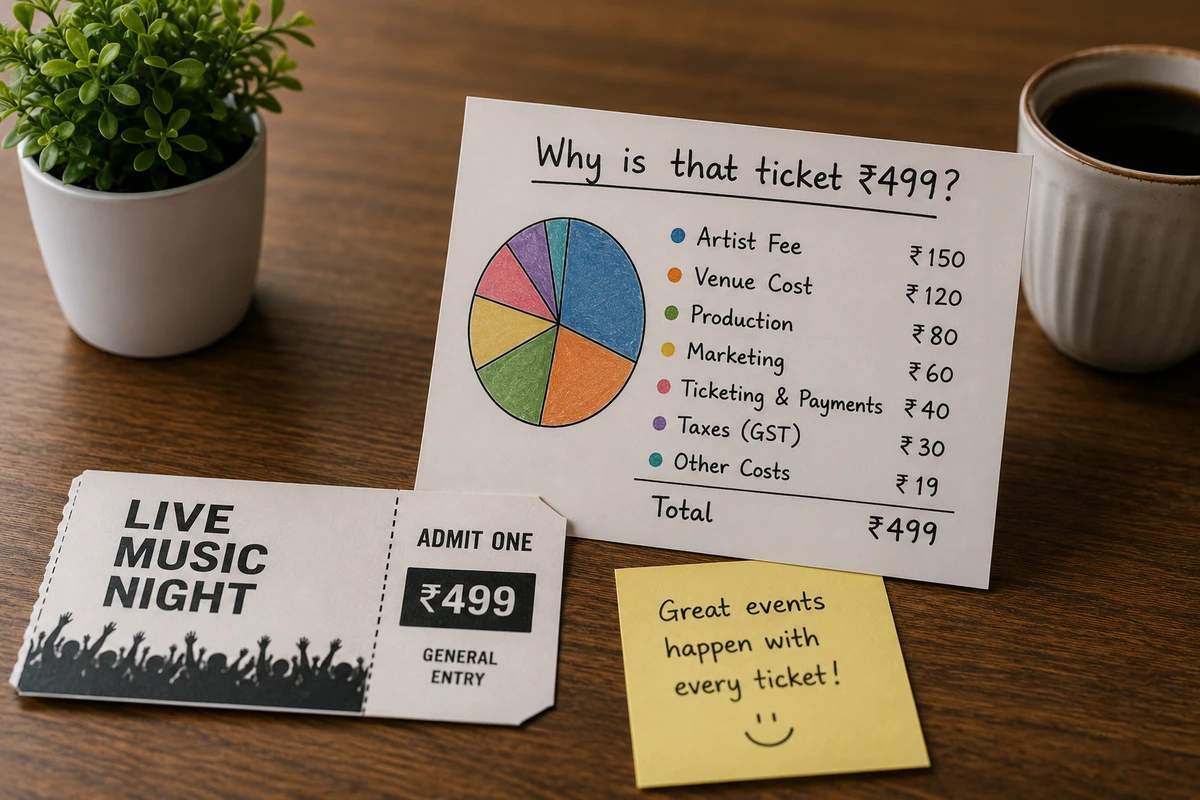
Why Is That Ticket ₹499? How Event Ticket Pricing in India Actually Works
The ₹500 GST line, early-bird economics, and unstandardised tier names — how ticket prices in India are really set, for buyers and organisers.
Read More about Why Is That Ticket ₹499? How Event Ticket Pricing in India Actually Works
How to Organise an Event in India — Licences, Budgets, Ticketing, and Everything In Between
From police NOCs and music licences to GST and QR entry — the complete organiser's checklist for running a ticketed event in India.
Read More about How to Organise an Event in India — Licences, Budgets, Ticketing, and Everything In Between
India's Concert Boom Is Real: Inside the ₹13,000 Crore Live Events Economy
From 130+ arena-scale concert days to tier-2 sellouts — the numbers behind India's live entertainment surge, and where it goes next.
Read More about India's Concert Boom Is Real: Inside the ₹13,000 Crore Live Events Economy