
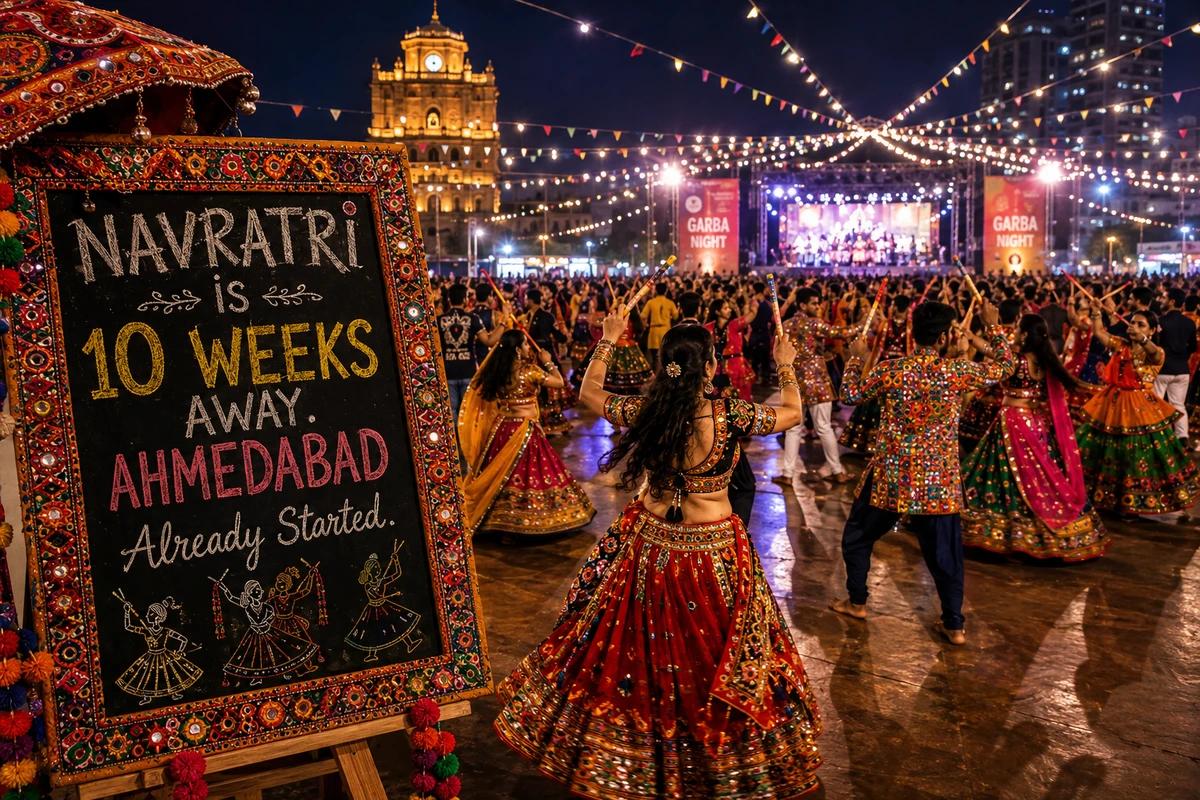
Artist calendars, ground bookings, tailoring queues and pass tiers all close long before anyone dances. Inside the season before the season.
Sharad Navratri 2026 begins on Sunday, 11 October. From today, that is ten weeks.
Nobody in Ahmedabad is dancing yet. But the decisions that determine what those nine nights look like — which grounds are open, who is singing, what a pass costs, whether you get the outfit you wanted — are being made now, in August, in rooms nobody photographs.
The festival everyone sees in October is the last ten per cent of it.
The artists were booked before the monsoon ended
A named garba singer performs one ground per night for nine consecutive nights. That is the entire supply. There is no second show, no matinee, no way to stretch it.
So a named artist's nine nights are allocated once and cannot be reallocated. Every ground that wants one is bidding for a fixed, non-expandable supply, and once it is committed the only remaining variable is what the ground charges you.
This is a large part of why two grounds a kilometre apart can price so differently for the same nine nights.
The grounds went before the artists
Ahmedabad has a finite number of usable party plots and open grounds, and the ones people actually travel to are a much shorter list than the total.
Booking a ground is only the start. Ticketed events in India need a set of clearances that vary by city and venue and are not instant, covering police permission, fire safety, temporary structures, power and sound. The details for organisers are in the guide linked below.
We have covered what this process looks like from the organiser's side in how to organise an event in India.
The dome decision gets made in July
Air-conditioned dome garba changed the economics of the season in Ahmedabad.
A dome is a structure hire, a cooling load, a power backup plan and a flooring contract, all committed before the first pass sells. Once that is taken on, the cost is sunk and the pass price has to carry it regardless of how any single night sells.
Open grounds have the opposite profile: lower fixed cost, more room to discount, more exposure to weather.
Tailors are the real deadline
The part of Navratri prep that catches people out has nothing to do with tickets.
Chaniya choli and kediyu work is seasonal labour concentrated into a few weeks, and custom stitching needs lead time that a ticket purchase does not. Rental stock is finite and sized, so what is available late is whatever nobody took earlier.
If more than one person in the house needs an outfit, this constraint often decides the festival, not the pass.
Passes open in tiers, and the first tier is real
Garba organisers need money before the festival, not after it. Grounds, stages, sound, power, security and artist advances are all paid up front, and pass sales are the working capital.
That is why early tiers on garba events are usually genuine and usually close. The size of the gap between an opening tier and a later one is set by the organiser and stated on the listing.
The full breakdown of how these prices are set is in our guide to garba pass prices in Ahmedabad.
Why this matters more than it used to
Garba is no longer only a local affair. UNESCO inscribed Garba of Gujarat on the Representative List of the Intangible Cultural Heritage of Humanity in 2023, at the committee's session in Kasane, Botswana, describing it as a ritual dance performed around a perforated earthen pot holding a lamp, moving from slow circles to a fast whirl.
The state runs its own programme alongside the private circuit. Gujarat Tourism hosts a Navratri festival at GMDC Ground in Ahmedabad, listed on the Incredible India festivals directory.
The practical effect is that Ahmedabad takes in visitors during Navratri who are planning around flights and accommodation rather than around which ground is nearest. That group has to book early, because the constraint they face is travel, not tickets.
What to do in the next ten weeks
August. Decide roughly what kind of night you want — open ground or dome, live mandli or DJ, one night or the full run. Early tiers are open and at their lowest. Get the outfit conversation started, particularly if anything needs stitching.
September. Most events are fully listed by mid-month. This is the last comfortable window to compare before committing. Book Ashtami and Navami now if you want them; they are the first to close everywhere.
Early October. Confirm timings, gate policy, ID requirements and parking for whatever you have booked. Expect the highest published prices and limited tier choice on anything still available.
11 to 19 October. Nine nights, running from around 8 PM until past midnight, most of them on working days. Plan the sleep, not just the tickets.
Current listings for the city sit on the Ahmedabad events page, and garba is under festival and celebration.
The wider picture
If you are curious how the same nine nights look elsewhere in the country — pandals in Kolkata, an elephant procession in Mysuru, a flower festival in Telangana — that is covered in Navratri across India.
But in Ahmedabad, Navratri is not a festival that arrives. It is one that gets built, starting about now.
Sharad Navratri 2026: 11 to 19 October. Vijayadashami: 20 October.
Related Articles
.webp&w=828&q=75)
Garba Pass Prices in Ahmedabad 2026: What You Actually Pay
A breakdown of tier names, weekday and weekend gaps, season pass maths, and the costs that turn up after you have already reached the venue.
Read More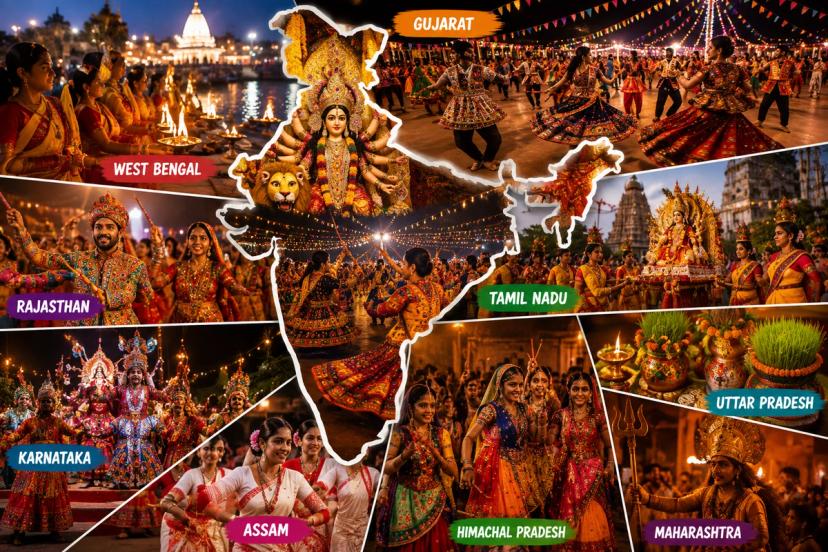
Navratri Across India: How 9 States Celebrate Nine Nights
Two carry UNESCO recognition. The rest range from a royal elephant procession to a nine-day festival built entirely out of flowers.
Read More