
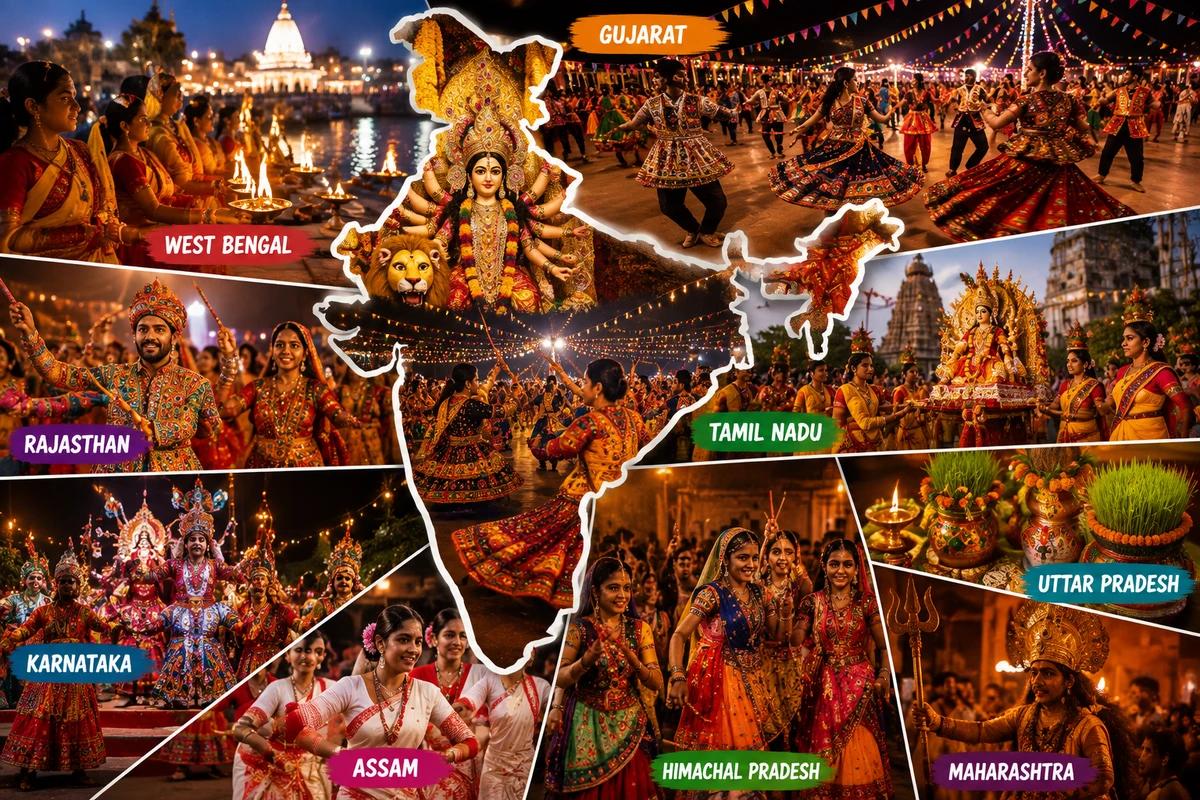
Two carry UNESCO recognition. The rest range from a royal elephant procession to a nine-day festival built entirely out of flowers.
Navratri means nine nights. What happens during those nine nights depends almost entirely on where you are standing.
In Ahmedabad it is a dance festival that fills grounds until 1 AM. In Kolkata it is a public art exhibition spread across a city. In Mysuru it is a state ceremony with elephants. In parts of Telangana it is a festival made of flowers, run by women, that most of the country has never heard of.
Sharad Navratri 2026 runs from Sunday, 11 October to Monday, 19 October, with Vijayadashami on Tuesday, 20 October. Here is what those dates mean in seven different states.
Gujarat: garba and dandiya
This is the version most people picture, and it is the largest participatory form of Navratri in the country.
Garba is danced in a counter-clockwise circle around a perforated earthen pot holding a lamp, called a garbo, or around an image of the goddess. It starts slow and accelerates across the night. Dandiya raas, danced with sticks in pairs, usually follows later in the evening.
UNESCO inscribed Garba of Gujarat on the Representative List of the Intangible Cultural Heritage of Humanity in 2023, at the committee's 18th session in Kasane, Botswana. It was India's fifteenth element on that list. The citation notes that garba is performed in homes, temple courtyards, village squares, streets and large open grounds, which is an accurate description of how completely it takes over the state for nine nights.
Scale is the distinguishing feature. Ahmedabad, Vadodara, Surat and Rajkot each run hundreds of organised events, from free society garba in residential compounds to ticketed grounds holding five figures a night. Gujarat Tourism runs a state programme at GMDC Ground in Ahmedabad, listed on the Incredible India festivals directory, alongside the private circuit.
If you are attending in Ahmedabad, the practical details are covered in our guide to garba pass prices, and current listings are on the Ahmedabad events page.
West Bengal: Durga Puja
The other giant, and a completely different proposition.
Durga Puja centres on pandals — temporary pavilions built by neighbourhood committees, each housing a clay image of Durga sculpted in the workshops of Kumartuli from Ganga clay. The images are commissioned months ahead, the pandals are designed around themes that change every year, and the last five days of the festival turn the city into something between an art circuit and a street carnival, with people walking pandal to pandal through the night.
UNESCO inscribed Durga Puja in Kolkata on the same list in 2021, at the 16th session. The inscription describes the festival as the clearest example of the public performance of religion and art, and as a working ground for collaborative artists and designers.
The festival closes with immersion of the images in the river, returning the clay to where it came from.
Karnataka: Mysuru Dasara
Karnataka observes Dasara as Nada Habba, the state festival, and Mysuru is where it is staged.
The city runs ten days of cultural programmes with the palace illuminated through the evenings. The event everything builds toward is the Jamboo Savari, the procession on Vijayadashami in which a decorated elephant carries a golden howdah holding the image of Chamundeshwari from the palace to Bannimantap, accompanied by folk troupes, horses and a torchlight parade.
This is a spectator festival rather than a participatory one. You watch it; you do not join in the way you would at a garba ground.
Telangana: Bathukamma
Bathukamma runs alongside Navratri and is specific to Telangana. It is a floral festival celebrated by women, using seasonal wildflowers — gunuka and tangedu chiefly — that bloom across the plains after the monsoon.
Flowers are arranged in concentric rings on a brass plate to build a conical stack, also called a bathukamma. Women gather in courtyards each evening, sing and move in circles around the stack, and then immerse it in a local pond. The Telangana tourism department notes that the smaller daily bathukammas lead up to Saddula Bathukamma, the finale, which falls two days before Dussehra, and that the immersion of large volumes of these flowers has a cleansing effect on the ponds.
It is also a homecoming festival. Married women traditionally return to their parents' homes for it. The festival is also listed on the Incredible India festivals directory.
Tamil Nadu, Karnataka and Andhra Pradesh: Golu
Golu, also called Bommai Golu or Bombe Habba, is the domestic version.
Households set up an odd number of stepped tiers and arrange dolls and figurines across them — deities, saints, historical figures, and increasingly scenes from ordinary life and current events. Families invite each other across the nine days to view the display, sing, and exchange gifts. Kolams are drawn at the entrance.
There is no ticketing, no venue and no crowd. It runs entirely on visiting.
Ayudha Puja on the ninth day, observed in both Tamil Nadu and Karnataka, extends the same idea to objects: tools, instruments, books and vehicles are cleaned and honoured. Children are traditionally started on formal learning on Vijayadashami.
Himachal Pradesh: Kullu Dussehra
Kullu begins when most of the country finishes.
The festival opens on Vijayadashami and runs seven days at the Dhalpur maidan. Its distinguishing feature is the assembly of deities: village gods from across the valley, reported at around 200 including Hadimba from Manali, are carried down in palanquins by their communities and gathered around the image of Raghunath, who is drawn through the ground in a chariot on the opening day.
There is no effigy burning, which is the standard Dussehra ritual across most of north India. The festival instead closes with the burning of a heap of wood and grass on the bank of the Beas, read as Lanka Dahan. The state has designated it an international festival, and it is listed on the Incredible India festivals directory.
Maharashtra
Maharashtra observes Ghatasthapana on the first day, with a pot installed and sown with grain that germinates over the nine days, and household worship of the goddess through the festival.
The public face in Mumbai and Pune is a commercial dandiya circuit, adapted from the Gujarati form. Navratri here also sits at the front of a festival stretch running through to Diwali.
Chhattisgarh: Bastar Dussehra
Worth noting as the outlier. Bastar Dussehra in Chhattisgarh is centred on the goddess Danteshwari and the local deity Mavli rather than the Ramayana narrative. It runs around 75 days, beginning on the new moon in Shravan and ending in Ashvin, which puts most of it outside the Navratri window entirely. Deities from surrounding villages are brought in procession to the Danteshwari temple at Jagdalpur, and the centrepiece is a heavy double-decker wooden chariot built with traditional tools. It is generally cited as the longest-running festival in India.
The Incredible India festivals directory carries listings for most of the events above.
What this looks like as a map
- Dance-led, participatory: Gujarat, and the Mumbai and Pune dandiya circuit
- Art and public spectacle: West Bengal
- State ceremony and procession: Karnataka, Himachal Pradesh
- Home-centred: Tamil Nadu, Karnataka, Andhra Pradesh
- Women-led and seasonal: Telangana
- Tribal and extended: Chhattisgarh
The through-line is Shakti — the festival is dedicated to the goddess in all of these — but almost nothing about the form is shared. A Gujarati garba ground and a Chennai golu display are the same festival in name and in nothing else.
If you are travelling for it
Nine nights of leave is unrealistic for most people, so the practical question is which two or three days to take.
For Gujarat, the peak is Ashtami and Navami, and prices and crowds are highest then. The first three nights are cheaper and less crowded, and the dancing is no different.
For Kolkata, the last five days are the festival. Pandal-hopping happens overnight, and accommodation needs booking well in advance.
For Mysuru, Vijayadashami is the day. The procession is the event.
For Kullu, arrive on or just after Vijayadashami, not before.
Listings across cities are on the festival and celebration category page.
Related Articles
.webp&w=828&q=75)
Garba Pass Prices in Ahmedabad 2026: What You Actually Pay
A breakdown of tier names, weekday and weekend gaps, season pass maths, and the costs that turn up after you have already reached the venue.
Read More
Navratri Is 10 Weeks Away. Ahmedabad Already Started.
Artist calendars, ground bookings, tailoring queues and pass tiers all close long before anyone dances. Inside the season before the season.
Read More